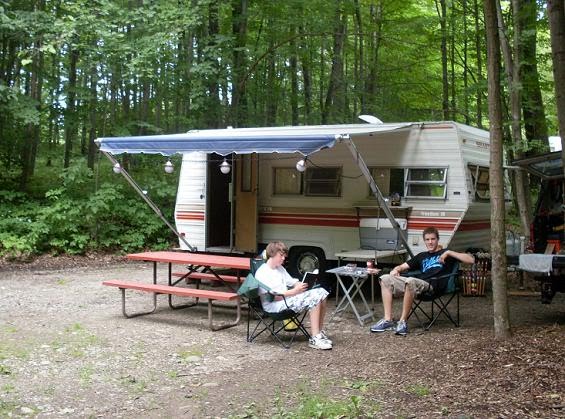
"We like camping better!" --Raymond Alexander Kukkee


view of the north shore Critter Pond, KOA Canandaigua NY [c] 2009 jcb

How to analyze a short story

In high school we all had to analyze short stories. It was dreadful and tedious for most of us. It was bad enough to have to read those dreary tales written by long-dead authors. Then we had to pick apart each paragraph, searching endlessly for similes, metaphors, foreshadowing and other unfathomable literary devices.

Now, as adults reading for pleasure and personal growth, we can take a more practical approach to analysis. (This approach works fine for students reading required writing, too, before addressing specific essay criteria.) To analyze a short story, ask questions the same way a reporter might organize a feature story.

First: did you like the story? A well-written short story will move you - to laughter, or tears, or enlightenment, or some other visceral reaction. Use your emotional reaction as a springboard for deeper questioning. On the other hand, if you found the story boring or confusing, expect to find negative answers to the rest of your questions.

As a 'reporter' your next question is usually, "who?" (first of the five W's). In a short story, "who" refers to the characters involved. Did the author develop his protagonist and accompanying cast well enough for you to care what happened to them?

the quintessential Hollywood cowboy, Sam Elliot A strong character will appeal to you personally because you can relate to him or her. You might feel empathy, sympathy, or revulsion for a character; but you should feel something. Good writers waste little time on topical descriptions of their characters. Instead, they use incidents and subtle clues in dialog and body language to show you, not tell you. Even minor characters should "pop" into your mind, vivid enough that you understand exactly why each one acts as he or she does.

Ask yourself next "what?" happened to those characters. Did the boy get the girl? Did the girl achieve stardom and fame? Did their child save a life? Something important happened in the plot, or the story wasn't worth reading at all. Captivating writing takes the reader to unexpected places, in unexpected ways, often with a tease of foreshadowing at first and a twist along the route.

Novelists know there are only about a half-dozen broad plot-lines available, so success comes via character development. If you were excited or surprised as the story unfolded, then the author told you a tale worth telling.

The third and forth w's are "when?" and "where?" Although these two are the meat of a news story, they are only the trappings for a short story. The era in which the plot evolves should have some crucial impact on the characters and the plot. The same is true for the setting.

wooded scene, covered bridge, Victor NY jcb 08 Neither provides a good excuse for long-winded descriptions of period automobiles, famous British landmarks, or colorful fall foliage. In a short story, belabored details like these signal padding for a thin plot or two-dimensional characters. Instead, the time and place should draw you into the story, transporting you away from your ordinary life into the extraordinary events unfolding on the pages you're reading.

"Why?" is the most difficult question to answer, the very same question responsible for all those baffling essay topics in school assignments. So ask yourself, "why did this author bother writing this piece?" Don't worry about similes and metaphors, and don't assume there's a hidden meaning in every tale. Just answer the question directly: "the author wanted to show how Love can overcome Adversity." (That's a pretty common theme in short stories, so it's a good sample answer.) The answer to "why?" helps define the sometimes elusive "theme" of a piece.

good short stories evoke emotional reactions in their readers Identifying and understanding the theme leads all the way back to the original question you asked yourself: how did this story make you feel? Did the author lure you into her fictional world convincingly? Did the things that happened to the people in the story seem interesting or important? Could you imagine yourself as the protagonist? Did you care?

If you weren't moved, then the author failed in some way, large or small, somewhere within those five W's. On the other hand, if you can't wait to read the next story by the same author, then she probably knocked at least four of those W's right out of the ballpark.

[Suggested reading, authors who consistently hit home runs in short stories: Jeffrey Archer (always a twist in the tale), John D. MacDonald (a master at character development), and Stephen King (whose short stories and novellas are often even better than his long tomes).]

copyright 2007 - all rights reserved

See, also: Practical Rules for Writers
Next installment will focus on developing characters your readers will want to meet.

Read this article at Helium.com...

Practical Rules for Writers

Let's talk about rules for creative writing, since the rules for more rigid styles are much too boring. First of all, there are no real rules! If you can engage your readers, and make them ache for more, then you have won the game fair and square. So let's just say, there are ways that work. Call them guidelines, if you wish.the author, Jim Bessey, at his desk in Upstate NY

Foremost of these: draw me in! Make me want to read whatever it is you've written. Maybe your title does the job. More often your first sentence provokes success or failure. If you can't bait the hook, you can't catch me as a reader. "Dan had just three weeks to live, but he didn't know that the day he won the Mega-Millions Jackpot." There, don't you want to keep reading?

Once you've snared a reader you must work your literary butt off to keep him (or her, of course). Keep your sentences reasonably short. Take your reader deeper into the story as quickly as possible. To continue the popular fishing metaphor, this is called 'setting the hook.' Make me care about "Dan" right away. Don't tell me the color of his hair or describe the jut of his chin! Tell me his flighty girlfriend left him waiting at a bus stop, so he went into a newsstand to kill time. (That's when he bought that fateful ticket, obviously.)

Here's a good "rule" no matter what: leave your fancy writing style at the door. Certainly, you have a 'voice' unique and wonderful. Just don't distract me with it, please. I want to find out why Dan will be dead soon; I don't particularly care about your astounding vocabulary. This always works: read some of what you've written aloud. Read it to a friend. Do you sound ridiculous, stilted, stodgy, or arrogant? A good friend will help you see that, before you get too heavily invested in your 'style.'

Rule number four is: okay, there are a couple of real rules after all. Let's lump them together so we can get it over with. (Yes, silly, you can end a sentence with a preposition if you want to. It's okay, really.) The two rules you must include are typically titled, "character" and "conflict."

Give me a character I can love or hate, or one I can relate to because he or she is so much like me. Then put your character (or characters; you can have more than one) in jeopardy. That's nuts-and-bolts stuff, not rocket science or anything earth-shaking. If you try to ignore this basic advice, very few readers will follow you to your final sentence.

This brings us to rule number five: the rest is up to you. You, and only you, can take me inside your imagined world. You may accomplish this with clever plotting, with vivid sensory detail, with careful use of foreshadowing, with humor, with fabulous insight into the human condition. Whatever. If you have followed the first four "rules" and if you can tell a tale at all, then you will reel in your readers almost effortlessly. The net with which you will land your big fish looks something like this: "I can't wait to read more!" There is no greater reward for a writer than that one priceless sentence. Now go cut some bait!

copyright 2007 - all rights reserved

See this story as it appears on Helium.com

Want to dig a little deeper? Leave a comment here, or have a look at How to Analyze a Short Story for more ideas.
In a future installment I'll look closer at creating characters your readers will want to meet.

Two plus Two is Five?


"Since when does two plus two equal five, Phil?" That was the response from my supervisor, Det. John Cowe. He tossed the report on my desk, and parked one substantial haunch next to my coffee cup.

"There's one more man to find, John. I'm sure of it," I told him. "Remember, that's how they found Pluto, even when they couldn't see it. Surrounding events made it clear that there was something out there. Same thing here."

"All right, Einstein, then prove it. Show me the fifth man," he replied. He shook his head and walked away, headed for the coffee pot in the break room.

There was a great deal we could prove about the North Star Bank killing. We had four men in custody. All four had given statements. Conflicting statements.

I had achieved a small bit of respect in the department, after just over a year on the Homicide detail. My last murder was closed with-in a week, thanks to a couple of lucky breaks. Even Det. Cowe had managed to offer me a well done, Gallagher' before he took my money. I had made a sucker bet in that case, though. This time Cowe wasn't making any wagers.

As murders go, this one wasn't too complicated. "Bank heist gone wrong" you might call it. The victim had been struck by a bullet that was never aimed at her. Lydia Herleigh was just an innocent customer who was in the wrong spot at the wrong time. The bullet had already struck a marble pillar and a metal chandelier before it returned to eye level and turned a bank robbery into a murder case.

Of course it was a messy crime scene. Too many witnesses who had covered their heads with their hands. Far too many clues collected by the lab guys, most of them worthless. A thousand fingerprints. The best part was we had four guns, all the same, all recently fired at the surveillance cameras. Too bad one of those shots hadn't killed Ms. Herleigh.

I pulled my mug of cold coffee closer and opened the case file so I could read it through for the hundredth time.

I set aside the statements from the four bank robbers for the moment, and began to go over the list of "innocent bystanders" once again. Somewhere on that list was, I believed, our fifth man or woman. I checked them off again, one by one, reading the familiar names under my breath as I went along.

"Angel Spyvee," wasn't a suspect. Head teller, twenty years on staff.

"Reginald Roy' Burton," branch manager. Perfect record, four years since his promotion. Scared senseless by the whole nightmare. Not a suspect.

"Tanya Barden," might be our hidden planet. Recently hired as a teller, there were some blanks in her background. I set her file aside for later.

"Bill Caster," the security guard. His gun had been taken from him before he could use it. He'd been forced to put on his own handcuffs before he was pushed into an empty office.

I had a sip of my aging coffee, rubbed my eyes for a minute, and continued on to the list of bank customers. One of them, I felt certain, had a pretty good chance of being the inside man (or woman) in this case. Each had been interviewed repeatedly.

I worked my way through the five names, looking for anything I might've missed.

Barbie Whitelock was, I felt, least likely of these. She was only seventeen, an honors student, and a good witness who didn't try to make things up to please her interviewers.

I wasn't so sure about Kenny Weld. His last name was perfect: he worked in the auto body shop around the corner. He'd been cashing his paycheck when the robbers burst in. His records showed a net worth of about ten dollars, which wasn't unusual for a single guy living at home.

Thomas Desmond, an unemployed car salesman from East Auburn (about ten miles away), had been about to withdraw some cash from his dwindling savings before the shooting started. He seemed a possible suspect, but I'd yet to make the connection.

Ramona Gaffighan was off my list altogether, so I shuffled her file to the back. She'd been banking at North Star since the days when it was Auburn Savings and Loan. Her walker might make a powerful weapon, but I didn't believe for a minute that she was a killer.

I saved Elizabeth Jung for last. There was something about her. Her age fell somewhere in between Barbie's and Ramona's, which left lots of room. She was single, self-employed, and mysterious.

When I first interviewed her I wondered if she was being evasive or merely uncertain. The only fact I could verify was her address. She had no bank accounts or credit cards, and claimed she worked on a strictly cash basis. I still had one of our investigators working on Jung.

My eyes hurt from reading. My head hurt from thinking. I got up from my cluttered desk and took a walk down the hall to find some hot coffee. Of course I bumped into Det. Cowe on the way.

"Did you find Pluto, yet, Carl Sagan?" he asked.

"I know who isn't Pluto, John," I said. "I'll figure it out one way or another." I raised my mug in salute as I continued to the break room.

Revived with coffee I brewed myself, I returned to my files. Time to look through the bad guys' statements again.

They had played a simple but effective game. Each one said that one of the other men was the ringleader. Not one would admit to firing the fatal shot. Ballistics from the mangled bullet failed to rule out any of the guns we'd recovered.

We could charge them all with accessory to murder. Every one would spend years in prison. I wanted it clean, though. One of the four, or a fifth one yet to be decided, was the actual murderer. With my pride at stake, I couldn't rest until I solved the mystery.

I took a notepad from my drawer and set out the facts for the four felons:

James Baisie, former tow-truck driver, was from a city fifty miles away.
Martin Rinaldi, unemployed computer technician, had an apartment in town.
Rocky Hanlon, part-time bouncer, also had a place here.
Alex Hemp, freelance photographer, lived on the east side in an old farmhouse.

I played with my pen for a while, drawing arrows and circling words, looking for connections. I still had Tanya Barden's paper there, too. Nothing about her tied her to any of them. We had checked and re-checked. I put her sheet back in the file.

I thought about Elizabeth Jung some more, too. I realized that I had focused on her merely because she was "interesting." I knew in my heart she wasn't involved. I was just romanticizing a random tragedy and trying to make it more mysterious than it was.

So I added the facts from Weld and Desmond to my list of the robbers:

Kenny Weld, worked in the auto body shop and lived with his mother in town.
Thomas Desmond, an unemployed car salesman, lived in East Auburn.

I drew some more circles and drank some more coffee. I had circles around "truck," "east," "auto," and "car." I stopped drawing, sat up straight, and yelled for Det. Cowe.

"John, come here a minute, will ya?"

After a minute he made his way to my desk. "Still think two and two makes five, Phil?"

"No I don't, John," I said, pointing to each circle in turn. "Two and two makes six, in this case!" I had found my connection, with two extra men, not one.

From there it only took another round of interviews to wrap things up. One by one we offered the tough-guys deals if each could identify the actual killer. We told each one we had statements from the two accomplices, and that only one more felon would get a break on sentencing.
Finally, we had three of them agreeing that computer geek Rinaldi couldn't hit a barn with a shotgun. His wildly aimed shot had killed Ms. Herleigh. It didn't matter that he never intended to harm anyone. Confronted with too much evidence to ignore, Rinaldi confessed at last. It had been his first and only criminal act. I hoped it would be his last one. He'd have plenty of years to think about it.

copyright 2007 - all rights reserved

Murder, Over A Dollhouse

"Murder, over a dollhouse? You've got to be kidding me." That was Det. John Cowe, who had at least ten years seniority on me. I smiled.

"Yup, husband says it's the only thing missing. Desimore believes him." Desimore ran the crime scene team. If he said the dollhouse was the only thing missing, I believed him. The husband, I wasn't so sure of.

"So why's a woman get killed over a stinkin' dollhouse, Phil? Ten bucks says the husband did it, and the toy's got nothing to do with it," said Cowe.

"No bet on that yet, John," I told him. "I've got some leads to run down."

He was headed upstairs for a meeting with the coffeepot. I was headed out to my department car. I had a witness to re-interview about this dollhouse caper, if you could call it that. I hoped he'd have something new for me.

I caught the case yesterday afternoon, and arrived just after the medics departed. She was a pretty lady living in a big house in a nice neighborhood, except when I got there she was dead. Four uniformed boys were already there, trying to look busy. I nodded at them and looked past the one blocking the door, a patrolman named Heape.

"What's her name, Scrap?" I asked him. His real name was Alexander, but none of us called him that. Some nicknames you just can't avoid.

"Rachel. Rachel Hanlyn," Heape replied.

"You touch anything?" I asked. "Nope," he answered.

"Crime lab been notified?" I said. "Yessir," Heape said.

My job was to ascertain the circumstances of the incident. That's cop-talk, which gets old after a while. I told Heape to run the book on this one.

"You get the paramedic's info?" We needed the names of everybody who'd been inside the house, for the book. I wondered if any of the other officers had been inside.

"When we got here the medics were waiting on the porch," he told me. "Big yellow Lab sittin' right next to 'em, waggin' his tail. He seemed pretty calm. Kester and Hurley checked all around outside. Nothin'."

"Who called it in?" I asked him.

"Neighbor did. Said he heard a scream, and a shot, and a loud motor. He's sitting in Kester's car, waiting."

I'd talk to the neighbor later. Three sounds were three clues. The witness's recollection of the timing could be important. First I had to get a closer look. I put on gloves and booties and stepped inside.

Mrs. Hanlyn was definitely dead. She lay in that classic pose you see on detective novel covers. She had been a slim brunette, thirties maybe, and casually dressed. There was a little blood around her, but nothing gory. She had a piece of paper in her right hand, a receipt of some sort. Lab guys would check that. There was a big, fancy table right next to her in the foyer. Just a trace of dust on it, but you could see a rectangle where something fairly large had been.

That was about all the quiet time I had with the deceased. A couple more detectives showed up and started canvassing the area. Two lab techs arrived and went to work. Heape logged everybody in, and sent his partner, Barton, to go shoo away the press. The husband showed up next, driving a black Lexus. He was frantic and weepy, wiping tears all over his thousand-dollar suit. Later, I'd ask him for his alibi. He didn't seem like a killer, but you never know.

He did explain the blank spot on the foyer table, though. That's where the dollhouse had been. It was an antique, from the wife's grandmother, made in Bavaria - her prize possession. Now it looked like she had died for it.

Three hours later we all agreed that nothing else was missing. Most of the rooms in the big, elegant house looked like pictures from a magazine. The only one that felt out of place was a room downstairs with a tavern-style bar and a well-used poker table. I'm not sure why that bothered me, but it did.

Before I headed back to my desk, I talked to the lab guys and sealed the house. The only real clue I had so far was the receipt Mrs. Hanlyn had been holding. It was for delivery of a color TV, but the weight listed was only five pounds. Didn't make sense, yet. That was yesterday afternoon.

I had pondered that a bit, gone home, slept, and returned today for follow-ups.

I wheeled my car to the curb and headed up the neighbor's walk. Time to go over his story again. He was expecting me, and met me at the door wearing some kind of leafy Hawaiian shirt. I tried not to let that distract me.

"Mr. Wood, thanks for seeing me again," I said.

"Detective Gallagher," Wood said, and invited me inside. "Just call me Kerry, please. Mr. Wood is my father and he lives out in California." We moved to the kitchen.

I wasn't there for chitchat. I pulled out my notebook and started right in. We went over the chain of events. Scream, shot, motor noises. I asked about the timing. Wood's account was consistent with last night's statement. The time from scream to vehicle leaving was at least a minute.

Now I needed more. "Can you remember anything else? Did you see anyone in the area, before or after?"

He thought for a moment, then his eyes widened. "UPS truck," he said, suddenly. "There was a brown van there, before." First time he'd mentioned that.

We talked a while longer, but I'd gotten what I needed - a break. The delivery truck, UPS or otherwise, had to have a driver. That driver was either a witness or a suspect. I've seen cases broken on a lot less than that.

Two hours and several phone calls later, I wasn't so happy. No record of any delivery by UPS, or any other company I could find. I hadn't been able to confirm or deny the husband's alibi, either. He had said he was at work. He was an investment adviser, with a private office and his own entrance, and no secretary.

While I worked at my desk, Det. Cowe stopped by.

"So, did you solve the case of the missing dollhouse, Phil?" he smirked.

"Not yet, John," I answered. "But you may be right about the husband. I'm keeping that ten bucks handy, just in case." He winked and wandered off.

Yesterday's canvas had been a bust. Big houses, thick walls, hardly anybody home. I was still waiting for phone records and financials, standard stuff. I thought about the receipt, and the brown van, and the yellow dog. Who the heck would kill for a dollhouse, even an antique one? Was the husband hiding something? I headed out to my car.

I had to go back to the other neighbors and try to find out more about the Hanlyns.

I got my next break an hour later, when I found one Rachelle de Bretagne two houses away. I could tell she came from old money. She had that air. She told me something about Mr. Hanlyn that clicked right away. He was a poker player, and not just a social one. He played host at least once a month, she said.

"Two Cadillacs, one Jaguar, a Lincoln, and a Mercedes-Benz ," she explained. She and I talked for an hour, over tea in the conservatory. I could barely write fast enough to take down everything she had seen.

The rest was legwork, and it took almost a week to straighten the whole thing out. Hanlyn's financials told us most of the rest of the story. Mrs. Hanlyn had her own money, from her mother's side. Mr. Hanlyn had over $100,000 in credit card debt, and owed another $40,000 on the Lexus. We'll never know how much he owed to his poker pals. Their expensive attorneys told us almost nothing.

We found the dollhouse, too, still in the color TV box. It was in a self-storage unit owned by a holding company, which we think was owned by the guy with the Jaguar. The brown van turned up in a weedy parking lot owned by another holding company. I knew we'd never locate the gun. We did, however, find the $30,000 insurance policy the husband had secured for the dollhouse. That was enough.

Hanlyn's lawyer didn't like it one bit, but remorse won out in the end. The husband was the "UPS" driver. He wore a disguise, and the gun was only supposed to be for show. He concocted the whole bizarre scheme to "steal" the dollhouse and collect the insurance. He was desperate, he insisted, and nobody was supposed to get hurt. Rachel had simply gotten in the way. Hanlyn cried so hard telling us the story, I was afraid he'd have a heart attack.

I gave detective Cowe his ten bucks. He was half right, after all. Murder, over a dollhouse. Go figure.

copyright 2007 - all rights reserved

One Mistake in a Frontier Town

Carl Duff was a bully, plain and simple. Well, maybe not so simple. He was the Sheriff, too. When Silver Creek was a newborn town, rough around the edges and growing quicker than the carpenters could build, the founders needed a man they could count on. They chose Carl. He was a big man, with a little education, and a decent shot with a Colt; and he was honest. No one was ever going to elect him mayor, but Carl was a man who could enforce the law (what little law there was) in a small and isolated mining town.

Maybe the townsmen acted too impulsively, or maybe acting the reliable lawman was one rung higher than Carl should have reached. There was blame enough to go around. Not to say that Duff was a bad Sheriff. He kept the peace, his way. If you didn't like it, you could leave. Not many chose to leave, though. Silver Creek had a broad main street, plank sidewalks mostly covered to keep off the rain, and loads of opportunities for ambitious frontiersmen. Three saloons offered a fine variety of food, drink, entertainment, and gambling.

Two merchantiles, one on each end of town, competed for business and kept each other at least mostly honest. There was a fine hotel in the middle, with decent beds and running water, started up by a wealthy Easterner who knew how things should be. Of course there were tents and shacks on the outskirts, while the hammers and saws ran dawn to dusk on the new-cut streets to put up houses for the swell of newcomers. There was plenty of money to go around, too. Silver was the currency, and it was there for the taking, for those who knew how to find it.


Carl liked to take advantage. That was the problem. He liked his coffee hot and strong, but he didn't think he should have to pay for it. Angela Thomas owned the only cafe so far, so she couldn't very well order Duff to take his business elsewhere. At least he paid for the eggs and bacon. Not that he ever left a tip. The only guy in town who could turn cowhide into boots had to figure on two or three free pair a year for the Sheriff, too. Duff never paid-up for feed or grooming at the stable, either. He figured all these things were perks that came with the job. He never lied to anyone, never stole a thing, never made an accusation he couldn't back with proof. He simply used his imposing size, the hard glint in his eyes, and the silver badge on his jacket as legal tender.

Oh, there were meetings, along with the expected grumblings from townsfolk. But what could they really do? Anyone tougher than Carl Duff was more likely to be on the wrong side of the law. That was a fact of life in small mining outposts all over the West. The bad guys always outnumbered the good ones. The fact that Carl was able to keep the peace within the city limits pretty much outweighed his petty selfishness. Things sometimes change for the better, just when you least expect it, though. And that's how Carl lost his cushy job.

It happened in the space of an hour on a blistering hot Tuesday afternoon. The road-weary stagecoach had make its once-weekly stop that morning. Four strangers had stepped off, booked a couple rooms at the hotel, and wandered over to the Starlight Tavern to chase the dust from their throats. Two tall men with two-day stubble and trail clothing, one middle-size fellow who could've been a lawyer, and a littler guy in vest and jacket: they looked a bit of a motley crew. Asked with ordinary curiosity, they replied as "just passin' through." They wanted whiskey, beer, and sandwiches; paid for everything in silver coin, not paper.

Hard to say, really, how the fighting started or even why. Accounts of the matter differ on important details. There were other hard men in town that day, as there often were; and nobody knew much about the passin'-through men, either. Regular townies, well-versed in survival strategies, hid behind furniture or departed by the back door as soon as voices were raised and chairs thrown aside. The first shot went right down into the oaken floorboards and didn't harm a soul. That one brought Sheriff Duff on the run, toting his Winchester for back-up.
Carl had a quick eye, and a fast hand on his Colt to go with it. That's how he kept order. He moved fast, he saw everything, and he responded quickly and decisively. Only Carl made an important error this time.

When he came trotting over to the scene of the brawl, he picked out the familiar lowlife types right off. Those he dismissed with snap-shots from his rifle, aimed at their feet, accompanied by his trademark glare. That left the four newcomers. Custom said to take the biggest and ugliest first, so Duff pistol-whipped the tallest one in about a half second. The second large man took the rifle barrel across his face during the other half-second.

Duff turned like an angry mountain lion and caught a swinging chair from stranger number three, the middle-sized fellow wearing lawyer clothes. One of Duff's big, free leather boots caught that one right where a man should never be kicked, and down went the lawyer-type in a groaning heap. What Carl didn't realize was that he'd already been shot, clean right through his gut, by the small well-dressed one who looked like a bank teller. Carl had put that one fourth on his mental list of priorities. By the time the little man had re-holstered his fancy chrome six-gun, gravity was dragging the sheriff to the dusty floor.

Carl didn't die that day, as he lay there in the saloon leaking blood into the sawdust. The town boasted one competent doctor who got him sewed up in time. A couple of capable locals rounded-up the out-of-towners and stowed them in the jail for safekeeping. The former sheriff spent the rest of his days using two canes to help him walk, serving as a lowly jail-guard for the new sheriff. The town fathers were much more careful hiring Carl's replacement. And Carl had to get used to paying a fair price for everything he needed.

copyright 2007 - all rights reserved