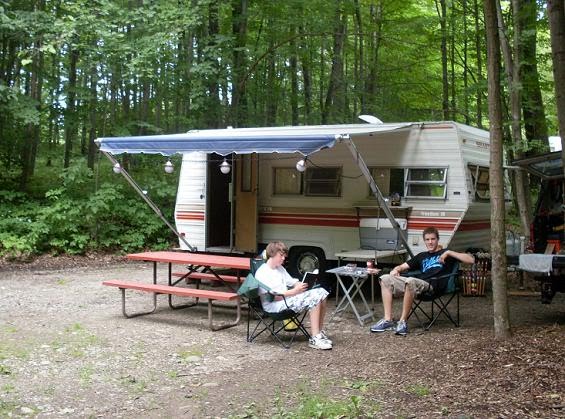
"We like camping better!" --Raymond Alexander Kukkee


view of the north shore Critter Pond, KOA Canandaigua NY [c] 2009 jcb

A perfect camping morning

Sunday morning, middle of the holiday weekend, I found myself in a perfect camping morning--entirely by accident. Lots of people choose this weekend as their first camping outing of the summer. We couldn't go this year; there was too much else crowding the plate. But I managed to sneak in a wonderful, unexpected camping morning, anyway. You see, I was awakened first at about 5:30 am, then second at about 6:00, by my sons' alarm clock--which was somehow set to go off as "music, then alarm" while the boys were away at their mother's house. Of course, I was angry initially, having been unintentionally cheated out of a couple hours sleep time. I was wide awake, though. Not much to do about it, but to stay up and make the best of it. It was far too fine a morning to waste in anger or frustration.

a view from the deckDead calm, about sixty-five degrees. Faintly misty dawn, devoid of mowers and passing cars. A pair of robins scouting breakfast, a fiery cardinal and a feisty blue-jay on reconnaissance. This was the domain of my backyard balcony deck, overlooking verdant spring suburbia. I poured yesterday's coffee atop a generous helping of french vanilla creamer, and disturbed the peace only long enough to let the microwave do its job. Grabbed a good, spine-creased and half-read paperback. Took drink and book and a pack of menthol lights, and found a comfy spot by the glass-top table. Chose a stowable but sturdy camp chair instead of the usual patio kind, and settled my sleepy self there unshowered and unshaved. That's when I realized I'd stumbled upon a perfect camping morning, right in my own back yard.

Why do we go camping, anyway? With the rising price of gas, I wonder if it's any cheaper to haul the camper around than it would be to book a hotel room. There is something very special about camping, though. For me it's always been about the absolute change of pace, place, and routine. Skip the shower. Get up earlier--or later. Savor a cup of bitter reheated coffee. Read a chapter or two, alone and phone-free. Take the time to actually notice a silent sparrow's passing flight. Let my wife sleep in. Have cereal instead of eggs. Listen for traffic and hear none! Listen to the radio, but ignore the news. Enjoy the feel of dewy grass on my bare feet, more enjoyable because the grass isn't mine and I don't have to mow it. Watch the sun come up over the trees to the east. And watch the kids stagger out of the camper, a little groggy and surprised to see me up ahead of them. Something different, but something simple and utterly ordinary. That's a perfect camping morning. I'll take one whenever--and wherever--I can get it.

There Goes Jericho

On May 16th, CBS announced the fall of Jericho. "Lost viewership" was the factor cited by Nina Tassler, the network's president of entertainment.. As we all know, shows come and go, and fans can be fickle. This month's top hit can be next month's ratings disaster; the variables are many, and network programmers rarely do viewers any favors as they (often inexplicably) juggle time slots. The woefully archaic Nielsen system can wreak havoc on new shows, especially when they take time off during the season. The cruelest standards of all are certainly applied to large-cast, multiple-location ("expensive") dramas like Jericho. Conversely, the most dedicated, loyal, enthusiastic, and vocal audiences are built by high-cost serialized dramas like Jericho--not by low-budget, quick-profit reality programs.

If a popular contestant-based show like Survivor was cancelled, dedicated watchers might feel some fleeting disappointment, accompanied by the consolation that it was fun to watch and had a good run. But when a network incinerates a well-received dramatic serial like Jericho, especially so early in its unfurling, fans are shocked and outraged. These are smart, thoughtful viewers who've invested their time and attention. They don't take the news lying down, either. Reader response to CNN.com's
Marquee Blog, (which helped debut the announcement), now runs to nearly two hundred comments. Most of the respondents mention the weeks-long "hiatus" and the harsh time-slotting suffered by Jericho. Dozens of commenters point out how unique this show was, and the broad family appeal it offered.


CBS message boards
Messages posted to the (soon-to-be-gone?) official Jericho
community number in the hundreds, with "views" reaching the tens of thousands. Writers have carefully collected and posted network contact names, addresses, fax numbers, email addresses and related links. New websites, blog sites, and message boards have cropped up immediately to rally support among Jericho fans. "Save Jericho" is the obvious battle-cry, and this blog does a fine job of gathering the current links and information. At least one major online petition continues to collect signatures--over 50,000 of them!-- calling for network action. Even after the claimed loss of audience, Jericho still had at least 8,000,000 loyal viewers. Most of them are not happy, and not afraid to say so.

The outpouring of fan support for this drama has been nothing short of awesome. These are witty, creative, and vocal viewers. They want some closure, at least. With the current variety of distribution outlets for video, we all just might get that closure. Every network has secondary channels for content rebroadcast; and there are plenty of other cable channels desperate for quality content. We have plenty of pay-per-download options, too. It won't be the same, though, as watching a show we love the first time it runs on a major network station. Those other delivery systems seem to devalue their offerings in comparison to what most of us grew up with. After all, how many videos are posted on YouTube right now--a million? Probably a lot more than that. The entire concept of "broadcast" is changing right before our eyes, however. Even something as straight-forward as TiVo has sent shock waves through the hallowed network corridors. Now you can receive television on your cell-phone, although I don't really understand why you'd want to. The message I'm seeing right now from Jericho's fans is simple: we want our Season Two, and we want it on our regular old teevee's!

The real question remains: where is this whole idea of network television headed? Are we asking too much of the airwave execs when we hope to find outstanding programs on our so-called free stations? When I wrote about Jericho originally, back around episode three, I expressed concern about the network's willingness to take risks with expensive dramas. Don't think for even a minute that "CBS cares." Their entertainment president, Tassler, frankly admitted in her first statement about this cancellation that "it's all about the money" (or words to that effect). The only valid reason CBS has for airing a high-quality drama is that drama's ability to attract millions of faithful viewers. If they could accomplish the same result by broadcasting the weather all day long, they'd do it! Fortunately, audience loyalty matters very much, as long as it's a big audience and there's a substantial profit to be made. So far the only viable way to gather faithful viewership is by providing some sort of high-quality programming. That order can now be filled, however, with less costly contestant-based fare like American Idol and Amazing Race. The financial success of these shows has led directly to the network executives' impatience with dramas. Jericho certainly isn't the first top-notch serial to be unceremoniously dumped; no chance it will be the last.

Here's the bottom line, literally. Fox's American Idol earned more than one hundred million dollars last quarter. Meanwhile, ten million intensely devoted viewers weren't enough to make Jericho profitable for CBS. Does that give you some idea of how expensive a show like Jericho is to produce? The only reason we still can see quality dramas on "free" TV is that the networks have found it very difficult to replicate Idol's success. Huge audiences still tune-in to see the various CSI's and Law & Order's. It's a good thing they do, or those programmes would be gone as well. For the rest of us, who are still searching for something more original and unusual like Jericho, there's not much hope. The time is approaching when we'll only see shows like that by subscription or pay-per-view. (And you can bet your last dollar they'll still be filled with commercials!) You'll want a bigger monitor for your computer, and the fastest Internet connection available--that's where you're going to find the best quality dramatic offerings. It won't happen this year, and maybe not next year; but it's coming. Keep your credit card handy, too, 'cause you're gonna need it. Ah, the wonders of technology, huh?

Here's my Spring project

While I was waiting for the good weather to show up, I dreamed up a warm-days project. I wanted to do something affordable, yet dramatic, to beautify our home. Whatever the reason, I settled on the idea of changing the way our boring old garage door looked--changing it by "fooling the eye." Have I ever tried anything like this before? Nope. I don't even like to paint, although as a homeowner now, I have to at least learn to tolerate it. Since a picture's value is well documented, I've included this photo so that you may judge the results for yourself.


I wish I'd thought to take a "before" picture, since that would show how dramatic the change really was. Our house was built in the early 1960's, and remains largely unchanged since then. The previous owner took extremely good care of the place, so most of what was here when we moved in last year was original. The paint and floor coverings were all fresh, but even the kitchen and bath fixtures dated back to the beginning. Anyway, of course this is the door that came with the house. It was patched and caulked, painted and repainted, and topped with a layer of grime from the constant traffic on our road. Washing this old door was actually the hardest part of the whole job. Otherwise, the new paint job was easy work, physically, but difficult mentally. I didn't have any experience with creating this sort of illusion. (There are only four real windows in the original--the ones that appear as a darker black in the photograph.)


There are a couple tricks to this illusion, nothing too fancy. First, the original door already had those nice panels in it, so I didn't have to create that look. Second, the existing windows were in the third panel from the bottom, so there was room to add-in the top row, in any configuration I wanted. I chose the arched-top design because it matched the house's main trim. The most important "trick" isn't a trick at all: the handles are real, metal handles of exactly the right kind. Everything else is paint! The reality of the two handles lends weight to everything else. The four hinges were created by masking and painting; I did add some real screws, but they're a minor detail. The crucial eye-fooling detail is the simplest of all--the vertical black line down the center of the door, which convincingly mimics the shadow-line created by two real doors. All together, we've invested in a gallon of white and a quart of black paint, a roll of masking tape, and a pair of handles. The result speaks for itself, for well under $100. Not too shabby, huh?

Long live the Spring!

Spring has officially arrived here in upstate NY. We had a very dicey April, with some nagging snowfalls and sagging temperatures. Until about one week ago, the trees were bare. However, since we lost nearly two full months from the '06-'07 ski season back around the New Year, we had to expect winter to hang on longer than usual.
Now, suddenly, our trees are filled with verdant leaves and all sorts of fabulous blossoms in shades from white to blood-red. All the flowers are blooming at once, racing to beat the freshly-sprouted weeds (which are growing faster than I can yank them out).


We have visitors now, unfortunately. When the snow finally melted I grabbed my leaf-rake and set out to rid our garden of last fall's crop of leaves, which I'd left throughout the garden as cover. As I swept the leaves out from among the plants, one of my three miserable rose bushes came along, too! You could have fit what was left of the rootball into a trial-size spice cannister. The culprit? Voles! I learned this by running a Google® search, of course. These voracious critters love all sorts of plant roots and bulbs, but especially favor tulips and roses. Though they are called garden voles, they seem to be a mouse of one sort or another. And there are a lot of them! They burrow into the ground via holes the size of golf balls, and leave ugly furrows just beneath the surface--easily spotted since the ground collapses into them.

How does one rid one's garden of these pernicious beasts? I haven't answered that question yet, but not for lack of effort. Being the sort who likes easy solutions, I tried "smoke bombs" first: they seemed the simplest and most devastating method. They also seemed to work, at first. I was easily deceived, and didn't hear the little monsters laughing at me there in their secret underground lairs. Oh, I'm sure a few of their valiant soldiers died in the struggle. Their funerals were well-attended, no doubt. The survivors have vowed to plow up every inch of my assorted gardens, to gobble every remaining bulb and root, and to colonize any previously unmolested sanctuary. They trip my silly mousetraps, and shun my delectable poison bait-packs. They do, however, very much approve of the lovely mulch I spread for them; they shuffle it all around to suit their needs each day. If I had a gun, and it was legal to use it here in the suburbs, I'd give it a shot. I've never actually seen one of these animals doing their dirty-work, so I can't imagine how I'd ever get a chance to snipe at them. If my cat was brave enough to go outdoors, and if she had any front claws, perhaps she could help in the war. I haven't thought of anything else that might work.

I'll continue the battle, but I won't utter any further complaint about the arrival of Spring. We had a long and odd winter, with only a single ski outing and just a few trips to our nearby sledding hill. Now the chill is gone from the air, and the threat of post-season snowfalls has passed. Spring here in western New York is notoriously short, and has to be savored whole-heartedly. The symphony of dozens of lawn-mowers fills the air, while gorgeous blossoming trees brighten every street. Nearly all the good TV shows have fired their final salvoes: it's time to get outside and enjoy our world. Summer will be here soon enough, with another dreary winter only moments behind it. What's not to love?

A digital prediction

We spent the afternoon today configuring our new wireless router. Can you think of anything more fun and entertaining than that? It certainly was a learning experience. My wife spent the previous night on hold with a revolving batch of tech-support people (for the cable provider) trying to troubleshoot our old router. None of them had a clue. We figured it out, step by step, with a dash of trial-and-error. I'm online now, so I can prove we succeeded, can't I?

All this wireless and digital stuff is tricky, though, no matter how persistent you are. You have to keep turning things off, unplugging cables, resetting switches, and trying all sorts of unlikely combinations. When our other router died (at least, we think it's dead), all its little green lights still worked just fine. The only hint we had that it was kaput was the fact that it, well, it didn't work. That was our first and only indication. Back in the olden days, when the TV was on the fritz (what the heck's a fritz, anyway??), you knew something important was busted. Somewhere inside the old beast would be a dead rat, or a fried tube, or a burned-out connection. You could smell it! There weren't any silly little green glowing lights trying to trick us into believing the television might still be OK. Either the guy at the repair shop could fix it, or it was time to toss the thing into a dumpster. All these fancy new electronic devices fail with mystery and intrigue, sometimes right out of the box--or other times after months of perfect performance. They don't give you any warning: no sudden flashes or crackles, no weird oily electricky smells, and not even the satisfaction of a dead picture tube. Instead we get "error messages." How droll!

You've all seen the cute emails with titles like "If Bill Gates made Automobiles." At one time or another, we've all been thankful that our TV's don't have to be rebooted or scanned for viruses and Trojans. (Well, I hope there aren't any Trojans inside the TV, anyway!) They are working on making televisions more digital and troublesome, however. Don't worry about that. We haven't even figured out how to program the VCR's that are already obsolete. Funny thing is, those older VCR's weren't really all that complicated. They had lots of buttons to push, and all sorts of menu's to navigate, that's all. The new generation of electronic entertainment crap is all run by software and "set-up wizards," which sounds a little scary to me. If you've replaced your "obsolete" cell-phone lately, you've seen first-hand how complicated a simple device can get. Pass the Bluetooth, will ya please? Take a minute, and go customize the noise your phone makes when you flip it open--that's important!

I am a little discouraged by the level of techno-savvy one has to have these days just to deal with things we now consider ordinary. But I don't actually want to rant about all that, and sound like some befuddled curmudgeon gorging on sour grapes. Playing with all these high-tech toys is fun, and I'm not that old. If you think about it, though, our current electronic economy feels like it's being guided by the geekiest kids you ever knew in high school, with unlimited budgets. Oh, wait, it is! Our "toys" do things we don't even know about--things we don't understand at all. We're so far beyond "hmmm, I wonder how they get sound and pictures to go through the air and into my teevee..." that it's not really even funny to say so. Some of the far-future ideas that wowed us in early Star Trek episodes look quaint today by comparison. Remember when we thought it was so cool that the doors opened automatically for Scotty and Captain Kirk? I'll bet when those fancy doors broke they could fix them!

Where's it all going, anyway? That's what I started out to talk about, a couple hundred words ago. It's much too easy to complain; let's speculate instead! Right now we've got our PC's, our wireless networks, our HDTV (and HD radio, too!), wxyz-compliant cell-phones, multi-function MP3 players, talking cars with bluetooth, and GPS for everyone. That's one big sh**load of acronyms and tons of fun for everyone! Quick, how many remotes do you own? Four? Six? Want to bet it's closer to ten? Take a second, think about it, count them, and see. Still got your old cell-phone sitting in a drawer somewhere? (I checked, we have three! Isn't there some charity that needs them??) How many different radios do you have lying around? (More than ten, here.) Got any non-HD-ready televisions left? (The end is near!) It's all headed somewhere very different, I believe, despite the obvious level of HDD displayed by the rich geeky guys like Steve and Bill G. There's some kind of critical mass building on the electronics horizon.

What we have now will all emerge in wild and unpredictable ways in the near future. Here's what I see in my somewhat murky crystal ball: First, the whole issue of remote-controls will boil down to just two. One will be the truly "universal" remote that controls your television, video-recorder, media-player, tabletop radio--whatever. Most of the buttons will be gone; you'll control it with simple voice commands like "record Law & Order QRSTUV" or "play music." (This one's already in the works, so that forecast is pretty reliable. The price has to come down about forty thousand dollars, however.) Your other remote will open and close the garage door, unlock your car doors, and still have that red button you can hit accidentally to summon help in supermarket parking lots. That one will probably have an MP3 player built-in, but just as a back-up to the one in your cell-phone.

All the parts and pieces will come together, of course. CD's will be only a fond memory soon enough (fact, not prediction). Digital-video recording on simple flash-type memory devices will replace every DVD, Blue-ray or otherwise. Expect to toss all those other components in the trash one day: VCR, DVD-player, stereo-tuner, portable CD-player (already almost gone), etc. One box will accept broadband TV and Internet, as well as provide for digital time-shifting like we get now via TiVo or DVR. That "box" could reside inside whatever becomes of our beloved boxy PC's and notebooks. Our high-def video "monitors" ("screens"?) will be wherever we want them, about one inch thick, as big as we can afford (or desire to afford), and receive their input signals wirelessly from the box I mentioned earlier. You already know you will be able to get whatever signal you want to see or hear on your mobile phone; the only question is how much will that cost? ("OK, you got yer Family-Media Plan for $79 a month, plus the usual surcharges, taxes, fees, and applicable limitations...")

The fact is, these changes will happen soon and we won't be surprised or impressed anymore. We've already seen that you can do damn-near anything with electronics, and make it as small as is acceptable or useful. Most of what we're futzing around with right now are simply old ideas morphing into their new forms. We're all very busy stomping out the figurative bugs created by the transition--bugs in the software, the hardware, and in our ability to accept and comprehend the new concepts. The soon-enough result doesn't require a crystal ball: everything except TV screens will be small, HD (or digital in whatever form), and ultimately portable. And wireless, of course. (Too bad for all those who make cables of various sorts, eventually.) There's no doubt at all that soon you will be able to make telephone calls, listen to music, surf the Internet, navigate to any destination, watch video media of all kinds, take moving and still photographs, consult your day-planner, unlock your car, and jump-start your malfunctioning heart--all with a single device the size of a Bic lighter or wristwatch. We're almost there right now. Two questions, though: What will it all cost? (per month, of course), and How often will it suffer fatal malfunctions?